
SPOILER-FREE SUMMARY
With about a month until convicted felon Elizabeth Holmes is set to go to prison for crimes of fraud she insists she didn’t commit, her family invites documentary filmmaker Nathan Fielder into their home full-time. This is a surprising move as Holmes has been reclusive to the media for years at this point and, in a complete 180 degree turn, Holmes and her live-in partner Billy Evans tell Fielder that nothing is off limits and they’re allowed to capture anything they want. The crew starts off with scheduled and/or loose recording sessions but graduates to moving into the guest house in order to truly take advantage of the access they’ve been given. Fielder notices that his expertise is in comedy and satire, not science-based filmmaking and confronts Holmes with the question of why pick him? If she’s innocent, why not pick a documentarian with a science background who could question and, in theory, support her alleged innocence by asking science-related questions? She responds curiously, stating she never really thought about that, considering her story a human one. Over the next few weeks, Fielder and his team witness bizarre behavior from seemingly everybody that walks into the house, further fueling the idea that nobody really knows what’s going on despite having cameras and microphones constantly present. How is that possible and can Fielder make a movie out all of this before time runs out and Holmes starts her prison sentence?
SPOILER-FREE REVIEW
The word magic is defined by Merriam-Webster as “the art of producing illusions by sleight of hand.” I’m not sure if transitioning a documentary into a biopic two hours in is a stroke of genius or a magic trick.
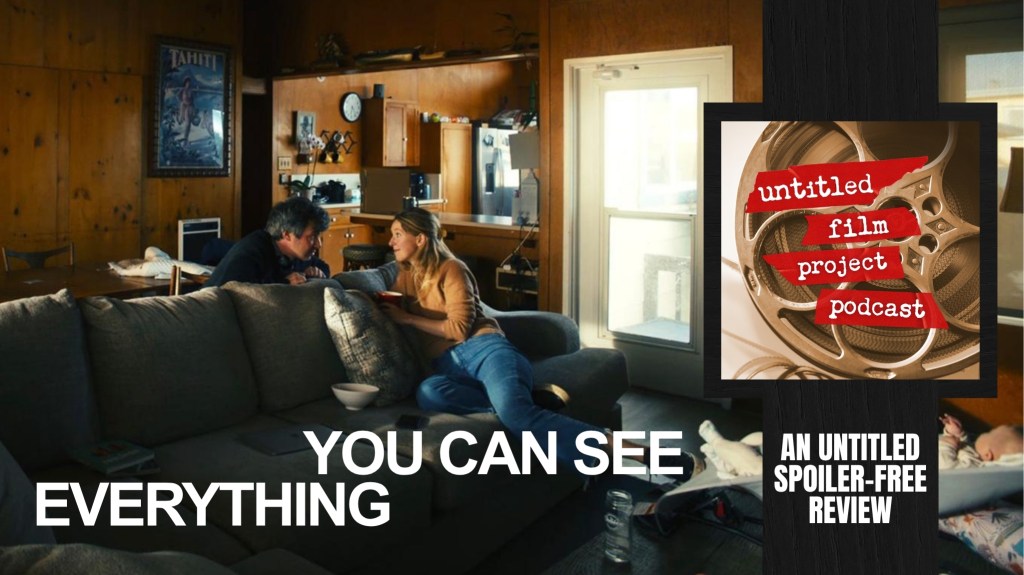
Regardless, I haven’t stopped thinking about YOU CAN SEE EVERYTHING since I saw it.
Fielder takes his unprecedented access and turns it into a nearly three-hour masterpiece but I’m still not sure how. We may need to consider the fact that this is lightning in a bottle. Not because Fielder isn’t good at what he does — he clearly is — but his execution, the subject matter, the magnetism of Holmes, Holmes’ soul-piercing gaze, the plainly (and painfully) obvious controlling personality of Evans, the willingness of actress Amanda Seyfried to go along for the ride, the aura of quality that exudes from A24 projects and the reality-show aspect of the whole thing are all ingredients in a concoction that’s borderline addictive.
This is not meant to discount Fielder’s work. Just that it’s possible he’s the Pat Riley to the Los Angeles Lakers, the Scotty Bowman to the Detroit Red Wings or the Casey Stengel to the New York Yankees. Those rosters did legendary things in their respective sports and it certainly took a great coach to steer the ship, but you could make an argument that those teams would’ve found similar success despite the coach behind the bench. They were that damn good.
If the biopic portion was truly a way to finish the story as accurately as possible without footage, or without compromising the legality of post-incarceration conversations, hand Fielder the Oscar right now. What a brilliant way to turn an expired clock into a finished product! But, if it was simply to divert the audience’s attention away from the fact that A24 didn’t have a movie without an ending, then, in theory, the filmmakers could have fabricated every piece of information following Holmes’ walking into Federal Prison Camp Bryan in order to provide drama.
Just like a magic trick.
At the end of the day, YOU CAN SEE EVERYTHING lives — nay, swims — in the awkward. From long, soul-piercing stares with Holmes’ big blue eyes to her subtle “whines” of suggested agreement to nervously re-worded questions to conversations conveniently cut short, this doc can be tough to watch at times.
In addition, many may see the Marvel-esque runtime and judge it as unnecessary but the filmmakers clearly needed every minute afforded them in order to develop the characters we’re seeing and situations we’re witnessing. From Billy standing in the shower to pointing out that Holmes’ father had worked at Enron to the dissection of words and how different people could translate them differently, everything shown matters.
Is YOU CAN SEE EVERYTHING brilliant? Is it a magic trick? Perhaps because we’re asking that very question is what makes it a masterpiece. Regardless, it’ll haunt you in the best way well after you leave the theater.
Just… wow.
JKG SCORE: 8.5 out 10

