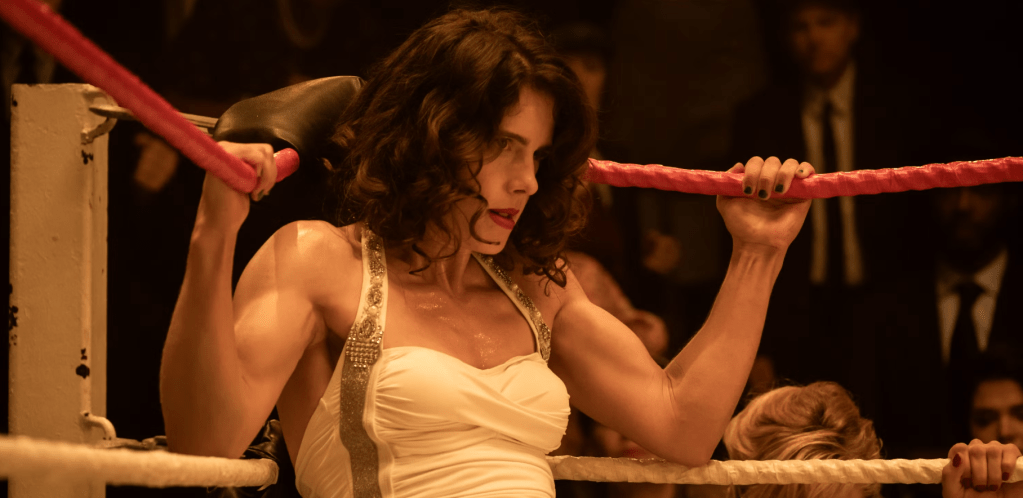
Before she became a pioneer in professional wrestling, Mildred Burke (played by Emily Bett Rickards), is a small town single mom who falls in love with the sport after going to a match. Bucking the gender trends of the 1930’s and 1940’s, Burke refuses to give up on her dream of performing in the ring and essentially forces her name into consideration to be trained by a local promoter named Billy Wolfe (Josh Lucas). Once she proves herself in the ring at traveling carnivals wrestling men, Wolfe’s roster of female wrestlers starts to grow, but it comes to light that he’s using his position of power to pressure them into private nightly exploits as well. This doesn’t sit well with Burke and she eventually makes the tough decision — especially for that era in American society — to split off from Wolfe. Through many trials and tribulations, Burke goes onto not only change wrestling and advance women’s rights but also to become the first female athlete worth $1,000,000.
The surprise of this film is Rickards. Known mostly as Felicity Smoak in the DCEU, it’s great to see her become the subject in a biopic. She’s completely believable as Burke and, depending on the scene, she brings a true range (including heart, empathy and passion) to the screen.
Lucas, on the other hand, was the opposite. For every five appearances he made, his delivery was distracting in three of them. He’s been great in other projects so I’m not sure if his abilities just couldn’t handle a lead villain role in a movie (versus his usual main roles in TV) but I’m willing to give him the benefit of the doubt based on his resume. Perhaps it wasn’t that he wasn’t ready for such a heavy lift but rather the vernacular of the time period made him come off as if he were “phoning it in.” At the end of the day, I found myself rolling me eyes at him more often than not.
Director Ash Avildsen did some great things here as well. He effectively develops characters, illustrates how difficult it is to wait for your chance and captures the time period in which the movie is set. Unfortunately, his failure to trim the fat is where this film suffers.
QUEEN OF THE RING clocks in at 2 hours and 10 minutes but it feels like four. If, say, 20 minutes had been trimmed off this thing, Avildsen would have a borderline wrestling classic on his hands. Instead, there’s large chunks of scenes that are unnecessary. In order to maximize its potential impact, the audience doesn’t need to see Burke’s son fantasizing about driving “Uncle Billy’s” car or more than a snippet of his female wrestling classroom or even some of the behind-the-scenes negotiations between promotion executives. They’re all “nice to haves” but not story-critical. Leave those things for the Director’s Cut or the DVD extras so the die hard fans can soak it all in while respecting the casual movie goers time.
If you’ve loved professional wrestling at any point in your life, you’re going to love QUEEN OF THE RING. If you enjoy a good biopic, you’re going to enjoy QUEEN OF THE RING. If you’re an ally of equality, you’re going to be ally of QUEEN OF THE RING. But everyone, regardless of buy-in level, is going to hate how long it is.
Love the story, hate the length.
JKG SCORE: 6.5
 Untitled Film Project